Free learning resource
How to Use ChatGPT for Beginners: Step-by-Step Guide (2026)
Learn how to use ChatGPT from scratch. This beginner-friendly guide covers prompts, writing, research, learning, business, productivity and practical ChatGPT examples.
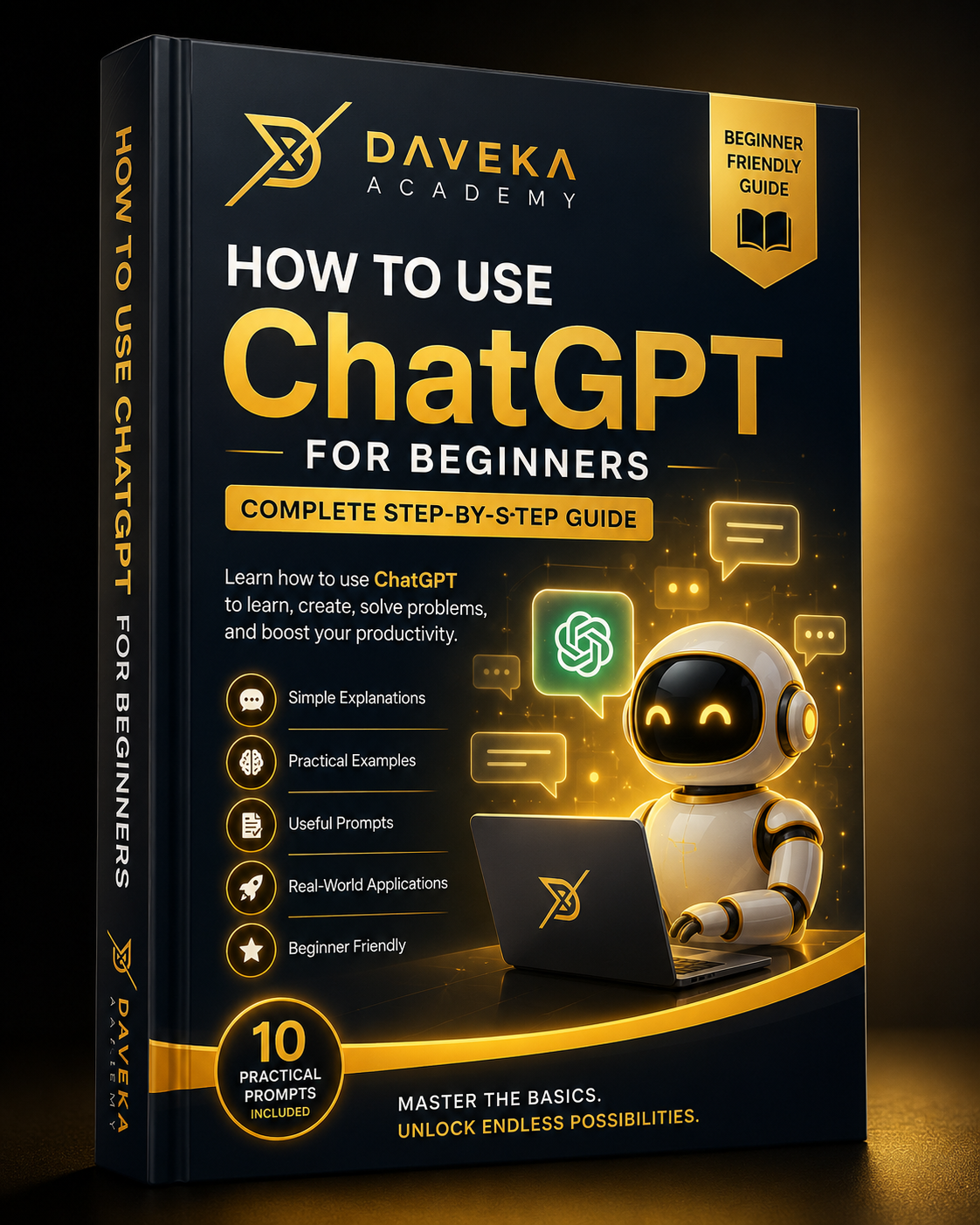
How to Use ChatGPT for Beginners: Complete Step-by-Step Guide
Artificial intelligence is changing how people learn, work, create content, run businesses, and solve everyday problems.
One of the most accessible AI tools available today is ChatGPT.
You don't need to be a programmer, technology expert, or AI professional to use it. If you can explain what you need in ordinary language, you can start using ChatGPT.
However, there is an important difference between simply using ChatGPT and knowing how to get useful results from it.
This guide will show you how.
What Is ChatGPT?
ChatGPT is an artificial intelligence assistant developed by OpenAI. You can communicate with it using normal language by typing or, where available, speaking your instructions.
Those instructions are commonly called prompts.
For example, you could ask:
Explain digital marketing to me like I'm a beginner.
Or:
Create a one-week social media content plan for a small fashion business.
The quality of the result you receive often depends on the quality and clarity of your instructions.
This is why learning how to write effective prompts is one of the most useful skills for working with AI.
What Can You Use ChatGPT For?
ChatGPT can assist with many everyday and professional tasks, including writing and editing, brainstorming ideas, studying, summarizing information, planning projects, preparing presentations, learning new skills, creating content, analyzing information, programming, and business research.
For example, a student could use it to understand a difficult concept.
A business owner could use it to brainstorm marketing ideas.
A content creator could use it to generate content ideas and outlines.
A job seeker could use it to improve a CV or prepare for an interview.
The important thing is to treat AI as an assistant rather than an unquestionable source of truth. Important facts, calculations, quotations, and professional information should still be checked.
Step 1: Start With a Simple Prompt
When you're beginning, don't worry about complicated prompting formulas.
Start by clearly describing what you want.
Instead of:
Marketing
Try:
Explain digital marketing to a complete beginner and give me five practical examples.
The second instruction tells ChatGPT what subject you want, your knowledge level, and what kind of answer you expect.
Step 2: Give ChatGPT Context
Context dramatically improves many AI responses.
Suppose you type:
Write an Instagram caption.
ChatGPT doesn't know enough about what you're promoting.
Instead, try:
Write an Instagram caption promoting an online beginner course on AI video creation. The audience is young professionals and entrepreneurs who have never used AI video tools before. Keep it simple and persuasive and end with a call to action.
Now the AI understands the product, audience, experience level, objective, and desired output.
Step 3: Tell It What Role to Take
Another useful technique is assigning the AI a role.
For example:
Act as a digital marketing strategist.
Then provide the task:
Act as a digital marketing strategist. Create a 30-day content strategy for a new online learning platform offering courses in AI, business and career development.
This gives the model additional context about the perspective from which it should approach the task.
Step 4: Specify the Output You Want
Don't make ChatGPT guess your preferred format.
You can request:
A table
Checklist
Step-by-step tutorial
Short explanation
Detailed report
Social media caption
Script
Lesson plan
Presentation outline
For example:
Give me the answer as a table with four columns: Topic, Content Idea, Platform and Call to Action.
This is much more precise than simply saying, "Give me some ideas."
Step 5: Add Constraints
Constraints tell the AI what it should and shouldn't do.
For example:
Write a 150-word LinkedIn post explaining why small businesses should learn AI. Use simple English, avoid technical jargon and end with one question.
Notice how specific that instruction is.
You have provided the task, length, platform, audience/style, and ending.
A Simple Prompt Formula for Beginners
You can remember this formula:
Role + Task + Context + Requirements + Format
For example:
Role: Act as a career coach.
Task: Help me prepare for an interview.
Context: I'm applying for a social media manager position at a technology company.
Requirements: Give me realistic questions and explain what a strong answer should contain.
Format: Present 10 questions in a table.
Combined, the prompt becomes:
Act as a career coach. I'm preparing for a social media manager interview at a technology company. Give me 10 realistic interview questions and explain what a strong answer should contain. Present your response in a table.
That's already considerably stronger than:
Give me interview questions.
10 Practical ChatGPT Prompts You Can Try
- Learning
Explain [TOPIC] to me as a complete beginner. Start with the basics, use simple examples and give me a short exercise at the end.
- Studying
Create a 7-day study plan for [SUBJECT]. I can study for [TIME] each day. Prioritize the most important topics.
- Business
Act as a business strategist. Give me 10 low-cost ways a small [TYPE OF BUSINESS] can attract more customers.
- Content creation
Create 20 social media content ideas for a [BUSINESS TYPE] targeting [AUDIENCE]. Divide them into educational, promotional and engagement content.
- Writing
Improve the following text for clarity and professionalism while keeping the original meaning: [PASTE TEXT].
- Job search
Act as a recruiter. Review the following CV for a [JOB TITLE] position and identify the five most important improvements I should make: [PASTE CV].
- Interview preparation
Conduct a mock interview with me for a [JOB TITLE] position. Ask one question at a time and give me feedback after each answer.
- Research
Give me a beginner-friendly overview of [TOPIC]. Explain the major concepts, important terminology and what I should research next.
- Productivity
I need to accomplish the following tasks today: [LIST]. Prioritize them based on urgency and importance and create a realistic schedule.
- Idea generation
Give me 20 ideas for [GOAL]. Avoid generic suggestions and explain each idea in one or two sentences.
One of the Biggest Mistakes Beginners Make
Many beginners type one short question, receive an average answer, and assume ChatGPT isn't capable of producing something better.
You can continue the conversation.
For example:
Make this shorter.
Give me three alternatives.
Make the explanation easier.
Rewrite this for university students.
Turn this into a presentation.
Give me more practical examples.
What information do you need from me to improve this answer?
Think of prompting as an iterative process.
Your first prompt doesn't always need to produce the final result.
Can You Trust Everything ChatGPT Says?
No.
AI systems can produce incorrect, incomplete, or outdated information. They can also misunderstand what you are asking.
Be particularly careful with medical, legal, financial, academic, and other high-stakes information.
When accuracy matters, verify important claims using reliable sources.
AI literacy isn't simply knowing how to generate answers. It also means knowing when to question, verify, and improve those answers.
How to Get Better at Using ChatGPT
The fastest way is practice.
Instead of only reading about prompting, choose real tasks you already perform and experiment with different instructions.
Compare:
Write something about my business.
with:
Act as a brand strategist. Write a 100-word description for an online academy that teaches practical AI, career and business skills. Target young professionals, students and entrepreneurs. Make the language clear, credible and aspirational without making exaggerated claims.
You will quickly see why prompt structure matters.
Take Your AI Skills Further
Knowing how to ask ChatGPT questions is the beginning.
The next stage is learning how to design prompts deliberately, control outputs, refine responses, and build repeatable AI workflows for real tasks.
Daveka Academy's Prompt Engineering course is designed to take learners beyond basic prompting and show them how to communicate with AI more effectively for practical work, learning, business, and content creation.
→ Explore the Prompt Engineering Course
FREE DOWNLOAD: 50 ChatGPT Prompts for Beginners