How to Learn Artificial Intelligence in 2026: Best AI Skills to Learn for Work, Business and Career Growth
Want to learn artificial intelligence but don't know where to start? Discover the most useful AI skills for beginners, careers, and businesses in 2026.
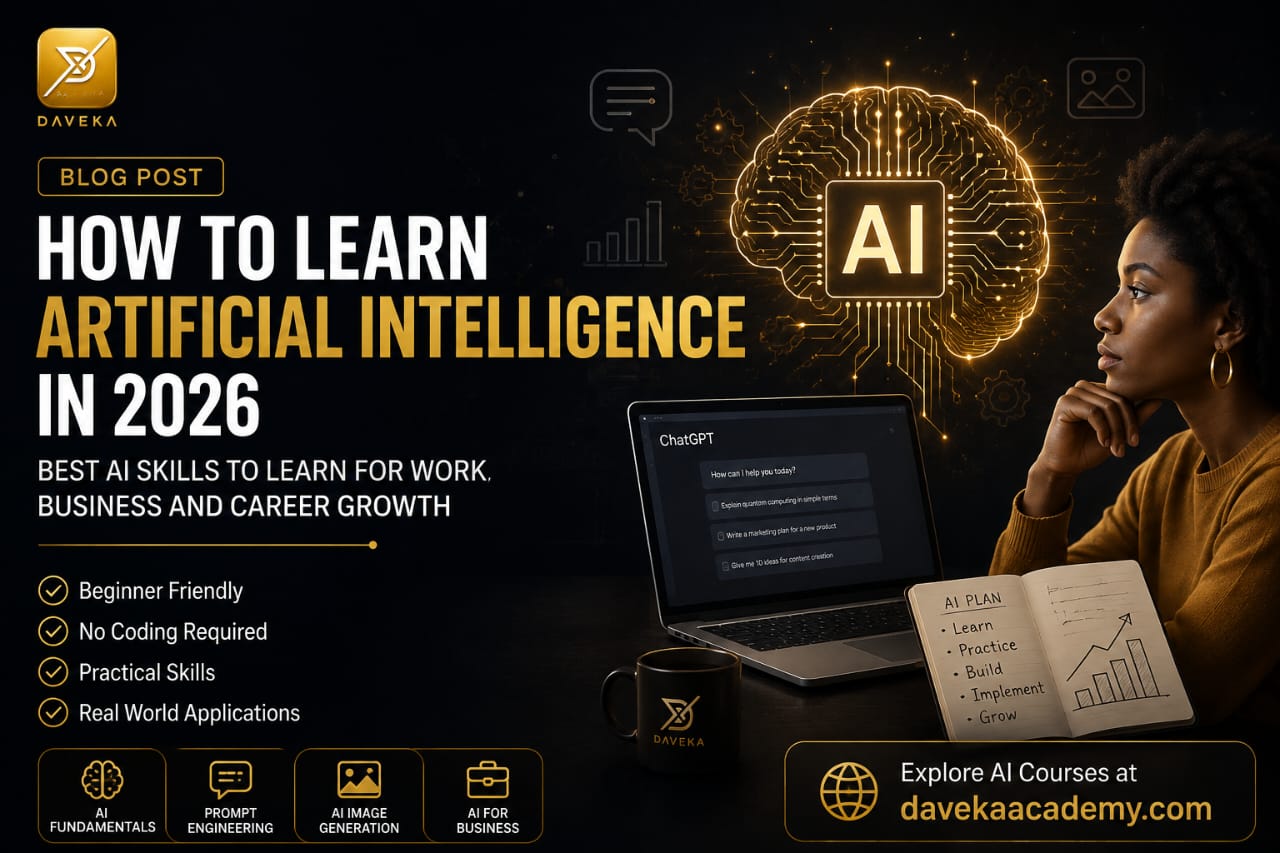
How to Learn Artificial Intelligence in 2026: Best AI Skills to Learn for Work, Business and Career Growth
Artificial intelligence is no longer something reserved for programmers, data scientists or large technology companies.
Today, students, entrepreneurs, designers, marketers, business owners and working professionals are using AI to research faster, create content, generate images, analyse information, automate repetitive tasks and improve business operations.
This has created an important question:
What AI skills should I actually learn in 2026?
If you are trying to start learning artificial intelligence but don't know where to begin, this guide will help you understand the most practical skills to focus on.
Do I need to know coding before learning AI?
No. You don't necessarily need programming knowledge to begin using artificial intelligence.
Many modern generative AI tools allow you to interact with AI using ordinary language. This means beginners can start learning practical applications before moving into more technical areas.
However, your learning should go beyond simply knowing how to ask ChatGPT questions.
The goal should be learning how to use AI to solve actual problems.
- Learn Artificial Intelligence Fundamentals
Before jumping from one AI tool to another, understand the fundamentals.
Learn what artificial intelligence is, how generative AI works, what large language models do, their limitations and how organisations are applying AI.
A good foundation makes it easier to understand new AI tools as technology changes.
If you want structured learning in this area, explore the Artificial Intelligence Fundamentals & Digital Transformation course at Daveka Academy.
- Learn Prompt Engineering
Prompt engineering is the ability to communicate effectively with generative AI systems.
A good prompt provides sufficient context, instructions, constraints and expected output.
Instead of:
"Write a marketing plan."
A stronger instruction could specify the business, audience, objective, budget, location, channels and required format.
The difference can dramatically improve the usefulness of the output.
Prompt engineering is particularly useful for research, writing, marketing, business planning, analysis, brainstorming and workflow automation. Current AI training programmes are increasingly teaching prompting as a practical skill alongside real business applications rather than treating it purely as theory.
You can develop this skill through Daveka Academy's AI Prompt Engineering & Generative AI Applications course.
- Learn AI Image Generation and Creative Visual Design
AI has also transformed visual creation.
Text-to-image technology can help people create concepts for advertising, social media content, product imagery, presentations, campaign materials and other creative work.
But producing professional-looking AI images requires more than typing a few words.
You need to understand prompting, composition, lighting, visual styles, consistency and creative direction.
Research into text-to-image systems has similarly found that effective prompting is a learned creative skill rather than something people automatically master.
If this interests you, explore the AI Image Generation & Creative Visual Design course.
- Learn How to Use AI in Business
Knowing AI tools is useful.
Knowing how to use AI to create measurable business value is more valuable.
Businesses can apply AI to areas such as customer support, research, marketing, content production, internal processes, data analysis, productivity and decision support.
This is where AI knowledge begins moving from experimentation to business transformation.
For professionals, consultants and entrepreneurs interested in this direction, Daveka Academy offers AI Consulting & Business Transformation.
Which AI skill should a beginner learn first?
A practical progression is:
AI Fundamentals → Prompt Engineering → AI Creation/Applications → Business Application
You don't have to master everything simultaneously.
Start with one skill. Practise it on real projects. Build examples of your work. Then gradually combine it with other skills.
Can learning AI help me get a job?
AI knowledge alone does not guarantee employment.
A stronger strategy is combining AI with an existing or complementary professional skill.
For example:
Marketing + AI
Graphic Design + AI
Business + AI
Writing + AI
Data Analysis + AI
Software Development + AI
Customer Service + AI
The combination gives you a clearer practical use case than simply describing yourself as someone who "knows AI."
Is AI worth learning in 2026?
For many professionals and entrepreneurs, yes—but focus on practical capability rather than hype.
AI tools will continue changing. Individual platforms may become less important over time.
The more durable skill is understanding how to identify a problem, select an appropriate AI approach, give the system useful context, evaluate its output and apply the result effectively.
That is why practical learning matters.
Start Learning AI with Daveka Academy
You don't need to learn everything at once.
Choose the AI skill most relevant to your career, business or creative goals and start building practical experience.
Daveka Academy provides practical courses covering artificial intelligence, prompt engineering, AI image generation, creative visual design, AI consulting and digital transformation.
Explore AI Courses at Daveka Academy (https://davekaacademy.com/?utm_source=chatgpt.com)
Learn the skill. Practise it. Build with it. Turn knowledge into opportunity.